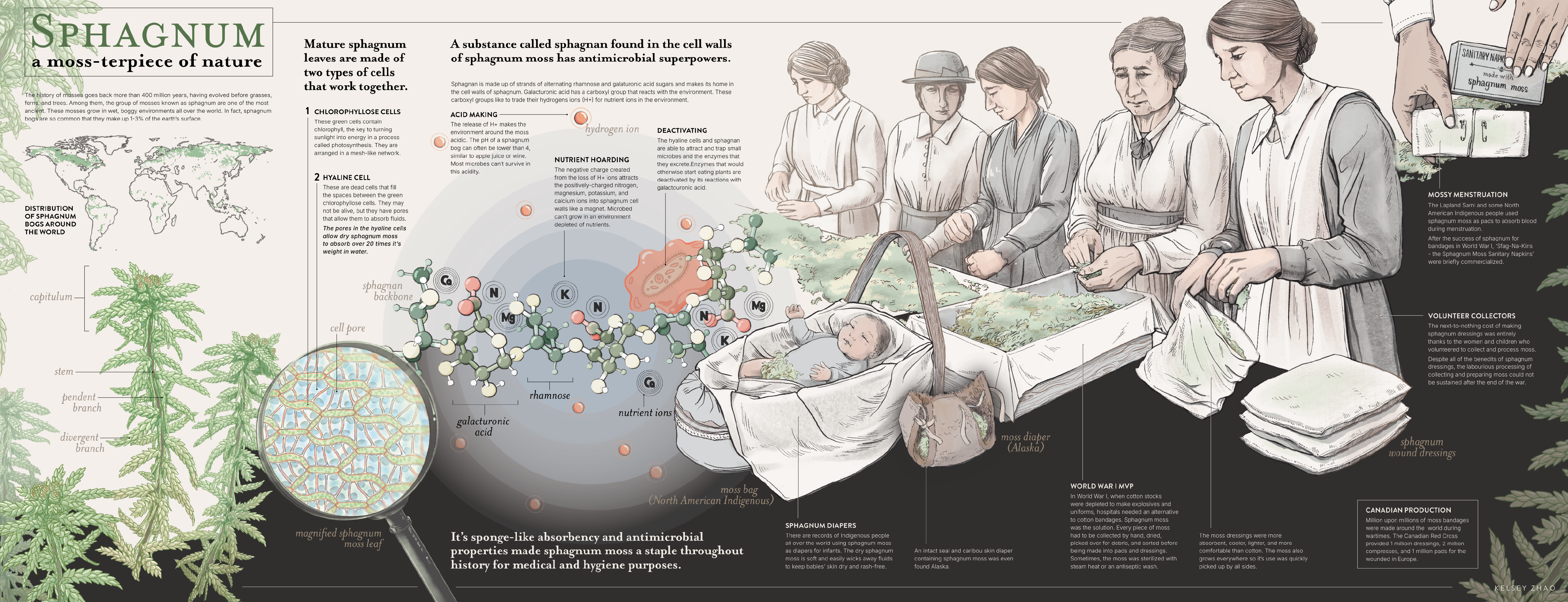
This information graphic is designed to educate the public on the unique cellular and molecular traits of sphagnum
moss and how these traits have shaped its use in health and medicine. The composition guides viewers through a
narrative that explores how the biological functions of sphagnum moss are tightly woven with its social and
historical story.
References
Albersheim, P., Darvill, A. G., O'neill, M. A., Schols, H. A., & Voragen, A. G. (1996). An hypothesis: the same six polysaccharides are components of the primary cell walls of all higher plants. In Progress in biotechnology (Vol. 14, pp. 47-55). Elsevier.
Ballance, S., Børsheim, K. Y., Inngjerdingen, K., Paulsen, B. S., & Christensen, B. E. (2007). A re-examination and partial characterisation of polysaccharides released by mild acid hydrolysis from the chlorite-treated leaves of Sphagnum papillosum. Carbohydrate polymers, 67(1), 104-115.
Boissoneault, L. (2017). How humble moss healed the wounds of thousands in World War I. Smithsonian Magazine.
Clymo, R. S., & Duckett, J. G. (1986). Regeneration of sphagnum. New phytologist, 102(4), 589-614.
Drobnik, J., & Stebel, A. (2017). Tangled history of the European uses of Sphagnum moss and sphagnol. Journal of Ethnopharmacology, 209, 41-49.
Hájek, T., & Urbanová, Z. (2024). Enzyme adaptation in Sphagnum peatlands questions the significance of dissolved organic matter in enzyme inhibition. Science of The Total Environment, 911, 168685.
Harris, E. S. (2008). Ethnobryology: traditional uses and folk classification of bryophytes. The bryologist, 111(2), 169-217.
Hotson, J. W. (1921). Sphagnum used as surgical dressing in Germany during the world war (Concluded). The bryologist, 24(6), 89-96
Johnson Gottesfeld, L. M., & Vitt, D. H. (1996). The selection of Sphagnum for diapers by indigenous North Americans. Evansia, 13(3), 103-7.
Kimmerer, R. W. (2003). Braiding sweetgrass: Indigenous wisdom, scientific knowledge and the teachings of plants. Oregon State University Press.
Kaczmarska, A., Pieczywek, P. M., Cybulska, J., & Zdunek, A. (2022). Structure and functionality of Rhamnogalacturonan I in the cell wall and in solution: A review. Carbohydrate Polymers, 278, 118909.
Nakamura, A., Furuta, H., Maeda, H., Takao, T., & Nagamatsu, Y. (2002). Structural studies by stepwise enzymatic degradation of the main backbone of soybean soluble polysaccharides consisting of galacturonan and rhamnogalacturonan. Bioscience, biotechnology, and biochemistry, 66(6), 1301-1313.
Oswalt, W. H. (1957). A western Eskimo ethnobotany. Anthropological papers of the University of Alaska, 6(1), 16-36.
Painter, T. J. (2003). Concerning the wound-healing properties of Sphagnum holocellulose: the Maillard reaction in pharmacology. Journal of Ethnopharmacology, 88(2-3), 145-148.
Porter, J. B. (1917). Sphagnum moss for use as a surgical dressing; its collection, preparation and other details. Canadian Medical Association Journal, 7(3), 201.
[Photograph of sealskin diaper]. Ethnology (UA2001-013-0279, Field number 262). UUA Museum of the North, P.O. Box 756960, 907 Yukon Dr., Fairbanks, Alaska. Retrieved from https://vilda.alaska.edu/digital/collection/cdmg3/id/809/
[Photograph of Sfag-Na-Kins - the Sphagnum Moss Sanitary Napkins]. Retrieved from https://americanhistory.si.edu/collections/object/nmah_729448